































What's changed, for 2026.
Regulatory activity in the region has picked up noticeably. Here's what's actually moved, as distinct from what's still just proposed.
A regional physical-presence requirement is coming, but isn't in force yet. The Eastern Caribbean Citizenship by Investment Regulatory Authority (ECCIRA), the body created to harmonise due diligence and standards across the five programmes, has member countries agreeing in principle to a 30-day physical presence requirement. As of this guide's last review, implementation has not begun and no start date has been confirmed. Treat any claim that a 30-day stay is "now required" as premature.
St Kitts & Nevis has introduced mandatory biometric enrolment. Applicants must complete biometric enrolment at a designated location (St Kitts itself, or partner locations including Dubai, London, Hong Kong, and others). Existing non-biometric passport holders have a compliance deadline to re-enrol or their older passport stops being valid.
Dominica is moving toward requiring in-person passport collection. This would end the programme's fully remote process, which has never previously required a visit to the island. An implementation date has not been confirmed.
The US has partially restricted visas for two of the five countries. Since 1 January 2026, US visa issuance has been partially restricted for citizens of Antigua & Barbuda and Dominica. The restriction does not affect existing visa holders and does not affect travel to those countries themselves, only US entry for new applicants from those two nationalities. Grenada, St Kitts & Nevis, and Saint Lucia were not included.
Interviews are now standard, not optional, across most programmes. Dominica, Grenada, and St Kitts & Nevis all require mandatory interviews for applicants above a certain age (16 for Dominica and St Kitts, 17 for Grenada), typically completed remotely.
We review this section on a rolling basis. If a client's decision hinges on any of the above, confirm current status directly with the relevant CIU before advising, since implementation timelines here have moved before.
Which countries offer it, and which don't.
Five countries currently run a Caribbean citizenship by investment programme:
- Antigua & Barbuda — since 2013
- Dominica — since 1993, the region's longest continuously running programme after St Kitts
- Grenada — since 2013
- St Kitts & Nevis — since 1984, the world's first modern CBI programme
- Saint Lucia — since 2015, the newest of the five
No other Caribbean nation currently offers a direct investment route to citizenship. Barbados, for instance, is sometimes searched alongside these five, but has no CBI programme; its citizenship is available only through standard naturalisation after continuous residency.
Will there be a sixth? Saint Vincent & the Grenadines.
Not yet, but it's the closest any new country has come in over a decade. Prime Minister Godwin Friday confirmed the plan in the government's February 2026 Budget Address: Saint Vincent & the Grenadines intends to launch its own citizenship by investment programme by mid-2026, which would make it the sixth Caribbean CBI nation.
What's confirmed: a mid-2026 launch target; proceeds will flow through a newly created, legislatively ring-fenced vehicle, the Saint Vincent and the Grenadines Investment Fund (SVGIF), rather than general government revenue; and the programme is being designed around a mandatory residency or "genuine link" requirement, a deliberate departure from the no-presence-required model the other five currently run on.
What isn't confirmed yet: the minimum investment amount, the specific qualifying routes (government indications point toward some mix of a national development fund, real estate, and infrastructure investment, but nothing is finalised), and processing timelines. Treat any specific figure quoted elsewhere for this programme as unconfirmed until SVG publishes its own legislation.
Worth noting for context: SVG's entry comes as the region faces real external pressure, both the US and the EU have signalled concern over Caribbean CBI due diligence standards over the past year, which is part of why SVG's own officials have been explicit that this won't be a high-volume, low-scrutiny programme like some of its neighbours.
Who each programme actually suits
There's no single "best" Caribbean CBI programme, only the one that fits a given investor's family size, budget, and travel priorities. Here's the short version before the detail, one card per profile.
BEST FOR SINGLE APPLICANTS
Dominica — from USD 200,000
- Lowest single-applicant entry point in the region
- Economic Diversification Fund, non-refundable donation
- Real estate route from the same USD 200,000 floor
BEST FOR LARGE FAMILIES
Antigua & Barbuda — from USD 230,000
- Main applicant, spouse and two dependents included at no extra cost
- Each additional dependent adds only USD 25,000
- University of West Indies Fund route covers a family of six for USD 260,000
BEST FOR US ACCESS
Grenada — from USD 235,000
- The only Caribbean CBI with a US E-2 investor visa treaty
- National Transformation Fund donation route
- Sibling dependents eligible, uncommon in the region
STRONGEST PASSPORT
St Kitts & Nevis — from USD 250,000
- Longest-running programme in the industry, since 1984
- Broadest visa-free access of the five
- Typically the fastest approval timeline in the region
MOST FLEXIBLE STRUCTURE
Saint Lucia — from USD 240,000
- Only Caribbean programme with a refundable government bond route
- USD 300,000 held five years, returned in full
- Widest range of investment options in the region
Cost, by applicant profile.
Single applicant
| Programme | Route | Minimum investment |
|---|---|---|
| Dominica | Government donation (EDF) | $200,000 |
| Antigua & Barbuda | Government donation (NDF) | $230,000 |
| Grenada | Government donation (NTF) | $235,000 |
| Saint Lucia | Government donation (NEF) | $240,000 |
| St Kitts & Nevis | Government donation (SISC) | $250,000 |
Dominica is the clear floor for a single applicant. Antigua's headline figure is priced as a family unit (see below), so a true single applicant pays a smaller share of that $230,000, worth confirming current single-applicant pricing directly with the CBIU, as some programmes structure this differently for solo investors.
Family of four (main applicant, spouse, two dependents)
| Programme | Total | Notes |
|---|---|---|
| Antigua & Barbuda | $230,000 | Spouse and two dependents included at no extra cost on the NDF route |
| Grenada | $235,000 | Same threshold covers single applicant or family of four |
| Saint Lucia | $240,000 | Same threshold covers single applicant or up to three dependents |
| Dominica | $250,000 | Rises from the $200,000 single-applicant floor |
| St Kitts & Nevis | $250,000 | Same threshold covers single applicant or up to three dependents |
Antigua is the standout for families: it's the only programme where the family-of-four price is lower than most competitors' single-applicant price.
Large families (6+)
Antigua & Barbuda's University of West Indies Fund donation route is built for this: a $260,000 contribution qualifies a family of six, with one family member also receiving a one-year tuition scholarship at UWI. Grenada and Saint Lucia both extend eligibility to unmarried siblings, which Dominica and St Kitts do not, worth flagging for clients with sibling dependents specifically. Beyond six, each additional dependent typically adds $25,000–$50,000 depending on age across most programmes, confirm current per-dependent fees before quoting a large family, as these are the figures most likely to have moved since the July 2024 regional price increase.
Caribbean Citizenship by Investment: Donation vs. Real Estate.
Before the country-by-country figures: this is the decision that matters more than which island. Every one of the five programmes reduces to the same fork, put money in with nothing back, or put money into a tangible asset with real conditions attached. Neither is objectively better; they suit different clients.
| Government donation | Real estate | |
|---|---|---|
| Capital returned? | No, 100% non-refundable | Potentially, after the holding period, subject to finding a buyer |
| Upfront cost vs. donation | Baseline (lowest entry point per programme) | Typically 20–40% higher than the donation minimum |
| Holding period | None, it's a one-time contribution | 5 years (Dominica, Antigua, Grenada, Saint Lucia); 7 years (St Kitts & Nevis) |
| Ongoing costs | None | Property tax, maintenance or management fees, resale/legal fees |
| Income potential | None | Possible rental income during the hold, if the project offers it (several featured projects above do) |
| Exit certainty | N/A, nothing to exit | Not guaranteed at full value; resale is typically limited to another CBI-qualifying buyer, which narrows the buyer pool |
| Processing speed | Generally the faster route, less due diligence complexity | Can take longer, property-specific due diligence adds steps |
| Best for | Clients who want the lowest total cost and simplest process, and don't need the capital back | Clients who want a tangible asset, possible income, and are comfortable with a multi-year hold and resale risk |
Saint Lucia complicates this framing usefully: its government bond route sits between the two, USD 300,000 held for five years and returned in full, with no property risk and no rental upside. For a client who wants their capital back but doesn't want real estate management, that's often the better-fit third option neither the donation nor the real estate route covers.
Worth being direct with clients about: "real estate" in CBI marketing sometimes implies an investment with upside. In practice, most CBI-eligible real estate is priced at a premium specifically because it qualifies for citizenship, and resale after the holding period is frequently at or below the original price once fees are accounted for. Position it as a citizenship route that happens to include an asset, not primarily as a property investment.
Real estate, route by route.
All five programmes offer a government-approved real estate option instead of a straight donation, useful for investors who want the capital tied to an asset rather than a non-refundable contribution.
| Programme | Minimum real estate investment | Holding period |
|---|---|---|
| Dominica | $200,000 | 3–5 years |
| Grenada | $270,000 (joint) / $350,000 (sole) | 5 years |
| Antigua & Barbuda | $300,000 | 5 years |
| Saint Lucia | $300,000 | 5 years |
| St Kitts & Nevis | $325,000 (shared/condo) up to $600,000+ (sole title) | 7 years |
Dominica is the cheapest real estate entry point in the region by a wide margin. St Kitts is the most expensive but also the only one offering full private-home ownership rather than shared hotel-share structures.
Saint Lucia is worth a separate mention here: it's the only programme in the region offering a refundable government bond, $300,000 held for five years and returned in full, which functions more like a security deposit than an investment.
Featured CBI-eligible real estate projects
A sample of the government-approved projects LGP works with across the region. All qualify toward the real estate route for their respective programme; availability and pricing change as units sell, so confirm current status before quoting a client.
Dominica
- Secret Bay — award-winning luxury resort on the west coast, rated among the Caribbean's best hotels; shares available from the CBI real estate minimum.
- Jungle Bay Eco Villas — Trip Advisor's top-rated Dominica property; villa shares available from the CBI real estate minimum.
Grenada
- True Blue Beach Residences — freehold studio apartments from $220,000, 5%+ annual return, 5-year buyback option.
- Silversands Residences — luxury freehold apartments and villas at Grand Anse Beach.
- Mount Cinnamon Resort — hotel suite shares, established beachfront resort near True Blue.
- InterContinental Grenada — hotel shares, launching 2025; 150+ rooms, meetings and business facilities.
St Kitts & Nevis
- Four Seasons Resort Nevis — multi-phase luxury redevelopment; fractional/resort-share ownership from the $325,000 shared-title minimum.
- Frigate Bay development — 400+ room resort project, St Kitts.
Antigua & Barbuda
- Moon Gate Penthouses — freehold luxury penthouses with optional income-producing rental programme.
Saint Lucia
- Current approved projects are limited; LGP maintains an updated shortlist on request rather than a fixed public list, since Saint Lucia's approved-project roster turns over more frequently than the other four.
Processing times, programme by programme.
| Programme | Typical processing time |
|---|---|
| St Kitts & Nevis | 3–6 months (fastest in the region) |
| Dominica | 3–6 months |
| Antigua & Barbuda | 3–4 months to CIU approval; total timeline can run longer with document preparation |
| Grenada | 4–7 months |
| Saint Lucia | 6–9 months, occasionally longer |
These are approval timelines from a complete, correctly filed application, not from first enquiry. Incomplete documentation or enhanced due diligence (applied to higher-risk nationalities or complex source-of-funds cases) extends every programme's timeline regardless of which one a client chooses.
Tax benefits, and their limits.
All five programmes share broadly the same tax profile for citizens who do not become tax resident: no obligation on worldwide income, no capital gains tax, and no inheritance or wealth tax tied to citizenship status alone. The tax benefit is realistic and significant for someone who becomes resident and structures around it, but citizenship by itself is not a tax event, it's the underlying residency and domicile position that determines what a client actually owes where. This is worth stating plainly to clients: holding a Caribbean passport does not, on its own, change an existing tax residency somewhere else.
Physical presence, not yet required.
Currently, none of the five programmes require an applicant to live in the country to obtain or maintain citizenship. Antigua & Barbuda is the partial exception: citizens must spend at least five days in the country within five years of registering to keep their citizenship in good standing, the lightest physical-presence rule in the region, not a relocation requirement.
That is expected to change. As covered in the 2026 updates section above, the ECCIRA member states have agreed in principle to a 30-day physical presence requirement across all five programmes. It has not been implemented and no start date has been confirmed as of this guide's last review. Any client weighing a "no residency requirement" pitch against this pending change should be told plainly that the rule is likely coming, just not live yet.
E-2 visa, the real US access.
This is the single biggest differentiator in the region and the one clients ask about most.
Grenada is the only Caribbean CBI country with an E-2 investor visa treaty with the United States. Grenadian citizens can apply for the E-2, which grants the right to live and work in the US for as long as a qualifying business investment there remains active, renewable indefinitely, though it doesn't itself lead to a green card. None of the other four programmes offer any equivalent pathway.
Separately: as of 1 January 2026, the US has partially restricted visa issuance for citizens of two Caribbean CBI countries, Antigua & Barbuda and Dominica, under a proclamation that does not affect existing visa holders. Grenada, St Kitts & Nevis, and Saint Lucia were not included in that restriction. This is a live, evolving policy area and worth flagging to any client for whom US travel is a priority, it changes the calculus on which passport actually delivers the most practical US access today, separate from the E-2 question.
Strongest passport, cheapest passport.
These are not the same programme, and it's worth being direct with clients about the trade-off.
Strongest: St Kitts & Nevis. The oldest programme in the world (1984) has built the deepest track record with foreign governments, and its passport carries the broadest visa-free access of the five, including destinations some of the newer programmes don't reach.
Cheapest: Dominica. $200,000 for a single applicant, with no other route in the region priced lower for one person.
The gap between them is real but not enormous, a few thousand dollars and a modest difference in visa-free reach. For most clients the decision comes down to family size and US-access priorities well before passport strength becomes the deciding factor.
The Lincoln CBI Passport Power Index, worldwide.
Every active citizenship-by-investment passport in the world, not just the Caribbean five, ranked by visa-free access. The Caribbean still leads outright: the top five spots on this list, and the strongest passport overall, all belong to Antigua & Barbuda, Dominica, Grenada, St Kitts & Nevis, and Saint Lucia. Thirteen active CBI programmes currently exist worldwide by our count; some trackers cite different totals depending on whether they include announced-but-not-yet-launched programmes, so treat 13 as the verified floor rather than a fixed ceiling.
| Rank | Country | Region | Visa-free access | Min. investment |
|---|---|---|---|---|
| 1 | St Kitts & Nevis | Caribbean | 155 destinations | $250,000 |
| 2 | Antigua & Barbuda | Caribbean | 154 destinations | $230,000 |
| 3 | Grenada | Caribbean | 147 destinations | $235,000 |
| 4 | Dominica | Caribbean | 145 destinations | $200,000 |
| 5 | Saint Lucia | Caribbean | 144 destinations | $240,000 |
| 6 | El Salvador | Americas | 134 destinations | $1,000,000 |
| 7 | Türkiye | Europe/Asia | 113 destinations | $400,000 |
| 8 | Vanuatu | Pacific | 88 destinations | $130,000 |
| 9 | Sierra Leone | Africa | 64 destinations | $100,000 |
| 10 | São Tomé & Príncipe | Africa | 61 destinations | $90,000 |
| 11 | Egypt | Middle East | 53 destinations | $250,000 |
| 12 | Jordan | Middle East | 49 destinations | $490,000 |
| 13 | Nauru | Pacific | 48 destinations | $90,000 |
Each linked passport has its own page with the full destination list by region and type of access.
Methodology note: visa-free figures and investment minimums cross-referenced against multiple published CBI trackers as of this guide's last review, not any single competitor's proprietary index. Programme terms, particularly Jordan's (revised by Cabinet in July 2026) and Nauru's (US$90,000 promotional pricing extended to 31 December 2026), change on their own timelines; reconfirm before quoting a client. Programmes with disputed or pending status (Malta's post-2025 framework, Argentina, St Vincent & the Grenadines) are excluded until confirmed operational.
In the pipeline: not yet active
Two more programmes are in development but not operational, so they're excluded from the ranked 13 above until launched. Included here for reference, not comparison.
| Country | Status | Expected investment | Visa-free access |
|---|---|---|---|
| Argentina | Pre-launch, expected Q4 2026, subject to ongoing legal review (the underlying no-residency decree was ruled invalid by two federal courts in June 2026, now before Argentina's Supreme Court) | $300,000–$1,000,000 (unconfirmed, estimates vary widely across sources) | ~170 destinations (current Argentine passport strength; unrelated to programme launch status) |
| Botswana | Pre-launch, targeted Q1 2026 but not confirmed operational as of this review; contingent on Parliament passing a dual-citizenship amendment, which Botswana does not currently permit at all | $75,000–$90,000 (final fee schedule not yet published) | Not yet confirmed |
Working with an agent, not around one.
Every Caribbean CBI unit requires applications to be filed through a licensed agent; none of the five accept direct applications from investors. This isn't a formality, it's a legal requirement written into each programme's governing act.
What an agent actually does: initial eligibility assessment, document preparation and certification, liaison with the CIU throughout processing, coordination of the mandatory interview where one applies, and submission of the final application on the client's behalf.
Interviews. Dominica, Grenada, and St Kitts & Nevis all require a mandatory interview for the main applicant and dependents above a set age (16 for Dominica and St Kitts, 17 for Grenada). These are typically completed remotely via video call with the relevant CIU or its representative, not an in-person requirement.
Choosing an agent or consultant. Look for direct CIU authorisation in the specific programme (not just general immigration credentials), Investment Migration Council membership, and a track record across multiple programmes rather than a single-country specialist, since most clients end up comparing at least two or three before deciding.
Who actually buys Caribbean citizenship
The programmes above answer "which one." This answers "why would someone actually do this," in the terms real clients describe their own situation in. Five profiles, drawn from the needs that come up most often across this desk.
PROFILE 01 — THE PLAN B
The global mobility diversifier
Already holds a reasonably strong passport, isn't relocating anywhere, and isn't in a hurry. What they want is insurance: a second, permanent, irrevocable citizenship that exists quietly in a drawer against the day their home country's politics, economy, or currency turns. Price and speed matter more than passport strength or family size, since it's often a single applicant or a couple. Typically fits: Dominica or Grenada, on cost; St Kitts & Nevis if the client explicitly wants the strongest document available and is willing to pay for it.
PROFILE 02 — FAMILY MOBILITY
The Egyptian HNWI building an exit for the whole family
An Egyptian passport carries meaningfully weaker visa-free access than most Gulf or Western documents, no visa-free Schengen, UK, or US access among them, which turns routine business and family travel into a standing visa-application burden. The driver here is rarely just the applicant; it's unlocking mobility, and eventually education access abroad, for a spouse, children, and often parents in one structured move. Typically fits: St Kitts & Nevis for the strongest resulting passport and its parent/grandparent dependent provisions; Antigua & Barbuda where family size and cost matter more than marginal passport strength.
PROFILE 03 — BANKING & TRAVEL FRICTION
The Nigerian businessman expanding internationally
Similar starting point to Profile 02: a Nigerian passport's visa-free reach is limited, and it compounds with a second, quieter problem, correspondent banking and account-opening friction that Nigerian passport holders can face at international banks regardless of personal net worth, a function of institutional risk policy rather than anything about the individual. A second, established Caribbean citizenship, presented alongside the Nigerian one, frequently eases both problems: fewer visas to plan international trips around, and a cleaner onboarding profile at banks that treat Caribbean citizenship as lower-friction. Typically fits: St Kitts & Nevis, whose age and reputation carry real weight with banks and border officers alike; Grenada where eventual US business access via E-2 is also on the roadmap.
PROFILE 04 — THE PERPETUAL TRAVELLER
The European entrepreneur structuring across borders
Based in an EU or wider European jurisdiction with a high domestic tax burden, and deliberately spreads citizenship, tax residency, banking, and business registration across separate countries rather than anchoring all of it at home, sometimes called flag theory in the industry. A Caribbean passport isn't about mobility for this client, a European passport already outranks every option on this page, it's about optionality: a second, permanent citizenship with no physical presence requirement, held independently of whatever EU residency and tax position they're actively restructuring around it. Worth flagging the pending ECCIRA 30-day rule to this profile directly, since it's the one client type here it actually affects. Often layers a Caribbean corporate structure on top; St Kitts & Nevis is the traditional jurisdiction for this, Nevis LLCs and business companies have a long-standing asset-protection legal tradition in the offshore planning industry. Typically fits: St Kitts & Nevis for the LLC/asset-protection infrastructure and banking relationships; Dominica for a lighter-footprint, lower-cost citizenship-only position without the corporate layer.
PROFILE 05 — THE AMERICAN RETIREE
The soon-to-retire American wanting a Caribbean second home
Different motivation entirely from the four profiles above: not fleeing instability or chasing visa-free access, an American passport is already among the strongest in the world, but buying into a real, English-speaking, direct-flight-from-the-US retirement base, with citizenship (and often the underlying property) as the vehicle. The real estate CBI route is usually the natural fit here, since the qualifying investment and the actual retirement home can be the same asset. This profile has its own tax and banking realities specific to US citizens, covered in full below. Typically fits: the real estate route in whichever island has the retiree's preferred lifestyle and flight connectivity, most often Antigua & Barbuda, St Kitts & Nevis, or Grenada; see the section below before advising.
Retiring in the Caribbean, what Americans need to know.
This gets its own section because the standard CBI pitch, tax-free worldwide income, no capital gains, no inheritance tax, doesn't apply the same way to a US citizen as it does to almost every other nationality on this page. That's not a flaw in the programmes; it's a fact about how US tax law works, and it needs to be said plainly rather than glossed over.
The one fact that changes everything for American clients: the United States taxes citizens on worldwide income regardless of where they live or what other citizenship they hold. A second Caribbean passport does not reduce, defer, or restructure a US citizen's US tax obligation in any way. The only way a US citizen exits US taxation is formal renunciation of US citizenship, a separate, irreversible decision with its own exit-tax regime, and not something this guide addresses or recommends without dedicated cross-border tax and legal counsel. Every American client should hear this in the first conversation, not discover it later.
Banking is friction, not freedom, for US persons. FATCA reporting obligations apply to any foreign financial institution holding a US person's account, and many Caribbean banks limit or decline US-person accounts specifically because of the compliance burden this creates, unrelated to a client's wealth or character. An American with a new Caribbean passport should not expect that passport alone to open Caribbean banking doors; some institutions will still ask about US person status regardless of which passport is presented.
So why do it? For this profile, the case isn't tax, it's lifestyle and asset structure:
- A genuine second home, not just a document. The real estate CBI route means the qualifying investment and the actual retirement property can be one and the same, unlike a straight donation.
- No relocation requirement. None of the five programmes require an American retiree to live there full time; it works equally well as a part-year base.
- English-speaking, Commonwealth-administered. All five are English-official with British-derived legal systems, a meaningfully easier transition than most alternative retirement destinations.
- Currency stability. The Eastern Caribbean dollar has been pegged to the US dollar since 1976, removing currency risk from budgeting a retirement.
- A passport for the rest of the family too, useful if children or grandchildren might want it later, or if political and economic diversification matters to the client beyond just themselves.
Flight connectivity, a genuine differentiator for this profile specifically. Unlike the other four profiles, where flight routes barely register, this is often decisive for a retiree choosing between islands. As of this guide's last review: Antigua, St Kitts, and Grenada each have direct or near-direct flight options from major US hubs (Miami, New York, Atlanta); Saint Lucia has direct seasonal US routes; Dominica currently has no direct US flights and typically connects via Antigua or San Juan, a real practical consideration for a retiree planning regular travel back to the US. Airline routes change seasonally; confirm current schedules before this becomes part of a client recommendation.
Real estate ownership specifics. Several islands apply an Alien Landholding Licence fee or equivalent for non-citizen property buyers outside the CBI real estate route itself; under the CBI route this is typically folded into the process, but worth confirming per-island before quoting an American client who may also be considering a non-CBI property purchase alongside or instead of the CBI application.
Country deep dives, one page each.
The comparison above answers "which programme." These five sections answer "tell me everything about this one," for the client who has already picked a country and needs the complete picture in one place.
Antigua & Barbuda
Established in 2013, Antigua & Barbuda's Citizenship by Investment programme is built around family value: it's the only programme in the region where a family of four costs the same as, or less than, most competitors' single-applicant price. The islands hold a total population of roughly 100,000, with Antigua home to the great majority of residents and Barbuda largely untouched. Tourism drives around two-thirds of the economy.
Eligible dependents: spouse; dependent children up to 30; parents and grandparents over 55; unmarried siblings under 18; a future spouse or child can be added post-citizenship for an additional fee.
Restricted nationalities: applicants from certain higher-risk jurisdictions face additional restrictions or are barred outright; the exact list changes periodically and should be confirmed with the CIU or an authorised agent at the time of application rather than quoted from memory.
Physical presence: five days in-country within five years of registering, the only maintenance requirement of the five programmes currently in force.
Document checklist (standard): birth certificate, certified passport copy, six recent passport photographs, proof of residential address, proof of name change if applicable, marriage or divorce certificate if applicable, military service record if applicable, education certificates for applicants over 18, professional reference letter, police certificates from every country of residence for at least one year in the past ten, custody or guardianship records where relevant.
Dominica
Dominica's programme, launched in 1993, is the second-oldest in the region and the most affordable for a single applicant. Known as "the Nature Island" for its rainforest interior, waterfalls, and diving, Dominica has issued citizenship to several thousand investors since inception and is regularly cited as one of the top ten diving destinations in the world, which matters to a specific slice of real-estate-route investors.
Eligible dependents: spouse; dependent children up to 30 (unmarried daughters under 25 do not need to be in education); parents over 65.
Restricted nationalities: Belarus, North Korea, Iran, Yemen, Sudan, Russia, and Northern Iraq are currently restricted; confirm before advising, as this list has changed before and enhanced due diligence applies to several additional jurisdictions.
Interview: mandatory for applicants 16 and older, introduced as a due diligence measure; typically remote.
Document checklist: disclosure form, fingerprint and photograph form, medical questionnaire and certificate, birth certificate, marriage/divorce certificates and name-change documents, police records from country of birth and every country of residence for more than six months in the past ten years, driver's licence and identity documents, eight passport photographs, proof of residential address, education diplomas, HIV test results (12+), routine blood and urine tests, professional reference, employment letter or financial statements, twelve months of bank statements, notarised affidavit of source of funds, and (where applicable) a notarised affidavit of support for adult dependents.
Grenada
Grenada's Citizenship by Investment Act came into force in 2013. Its defining feature is the only E-2 investor visa treaty with the United States held by any Caribbean CBI country, a genuine differentiator rather than marketing language. Grenada is also home to St George's University, a well-regarded medical school, and citizens receive a substantial tuition discount there.
Eligible dependents: spouse; dependent children up to 30; parents and grandparents over 55; unmarried siblings under 18. Grenada is the only Caribbean programme whose citizenship law extends automatically to the third generation and beyond.
Restricted nationalities: Afghanistan, Belarus, North Korea, Iran, and Sudan are typically restricted. Notably, per LGP's own review of the programme, Grenada has not banned Russian nationals from applying, a point of difference from the other four programmes that's worth confirming is still current before repeating to a client.
Interview: mandatory for applicants 17 and older.
Document checklist: standard set consistent with the region (birth certificate, certified passport, police clearance, medical exam, proof of funds, photographs); Grenada's CBI Unit publishes the current definitive list, confirm against it directly rather than assuming parity with the other four programmes.
St Kitts & Nevis
Launched in 1984, St Kitts & Nevis is the original Caribbean CBI programme and, at its peak, this industry accounted for roughly a quarter of the country's GDP. More than 20,000 passports have been issued since inception. The country now requires biometric enrolment (see 2026 updates above), a step toward the kind of standards typically associated with EU and US naturalisation processes.
Eligible dependents: spouse; children and stepchildren under 18, or up to 30 if in full-time higher education or financially dependent; parents and grandparents over 55 who live with and are supported by the main applicant; a physically or mentally challenged adult child. Dependents can be added at any point after the main applicant receives citizenship, not only at initial application, unusual among the five.
Restricted nationalities: Russia, Belarus, Iran, Iraq, Afghanistan, North Korea, and Cuba are currently barred regardless of current residence.
Interview: mandatory, conducted in person or virtually at a St Kitts & Nevis consulate or embassy.
Document checklist: C1–C3 application forms, birth record, national ID and passport copies, HIV test (12+), police clearance, six recent photographs, proof of residential address, employment letter, business licence or incorporation documents if applicable, marriage or divorce documentation, source-of-funds statement and affidavit, affidavit of financial support for dependents aged 18–30, university degree certificates if applicable, limited power of attorney, and proof of biometric enrolment.
Saint Lucia
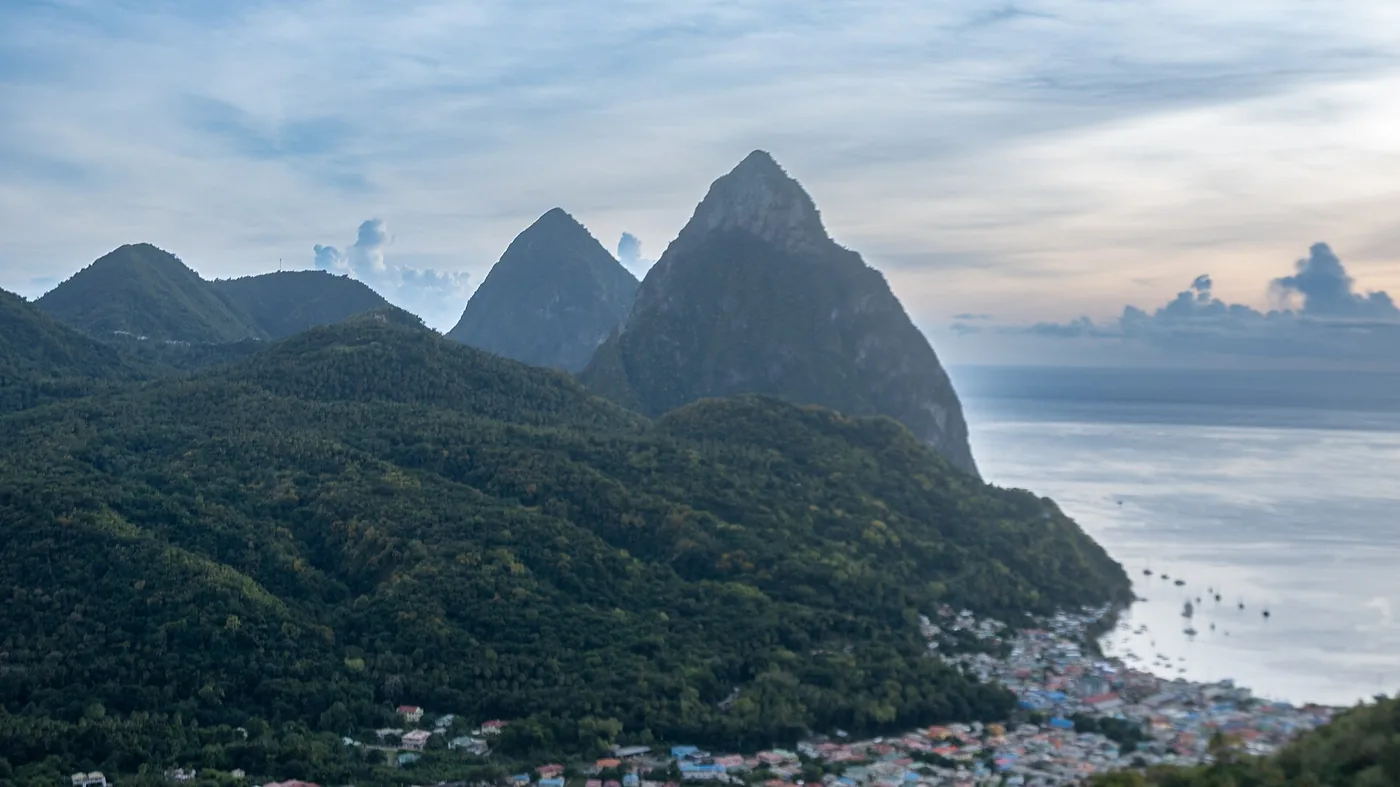
The newest of the five programmes, launched in 2015, Saint Lucia distinguishes itself with the widest range of investment routes in the region, including the only refundable government bond option. The island is best known for the twin volcanic Pitons and a well-developed luxury tourism sector.
Eligible dependents: spouse; dependent children up to 30; parents and grandparents over 55; unmarried siblings under 18.
Restricted nationalities: Russian and Belarusian nationals are currently prohibited from applying.
Interview: a mandatory interview and identity verification process applies to applications submitted from a set date onward; confirm current status directly, as Saint Lucia's requirements have shifted more than once.
Document checklist: birth certificate, certified passport copy, six recent photographs, proof of residential address, name-change documentation if applicable, national ID if applicable, marriage or divorce certificate if applicable, military service record if applicable, affidavit from spouse or ex-spouse regarding children where relevant, affidavit of support for dependents, education certificates, professional reference letter, police certificates covering every country of residence for at least one year in the past ten, custody or guardianship records where relevant.
The full comparison, side by side.
| ◆ Antigua & Barbuda | ◆ Dominica | ◆ Grenada | ◆ St Kitts & Nevis | ◆ Saint Lucia |
|---|
| Antigua & Barbuda | Dominica | Grenada | St Kitts & Nevis | Saint Lucia | |
|---|---|---|---|---|---|
| Single applicant | $230,000 | $200,000 | $235,000 | $250,000 | $240,000 |
| Family of 4 | $230,000 | $250,000 | $235,000 | $250,000 | $240,000 |
| Real estate from | $300,000 | $200,000 | $270,000 | $325,000 | $300,000 |
| Refundable bond option | No | No | No | No | Yes |
| E-2 US visa eligible | No | No | Yes | No | No |
| Interview required | No | Yes (16+) | Yes (17+) | Yes (16+) | Yes |
| Processing time | 3–4 months | 3–6 months | 4–7 months | 3–6 months | 6–9 months |
| Physical presence | 5 days within 5 years | None currently | None currently | None currently | None currently |
| Best for | Large families | Single applicants, lowest entry | US access | Passport strength, speed | Flexible/refundable structuring |
Figures reflect government fund and standard real estate minimums as of this guide's last review and exclude processing, due diligence, and passport fees, which typically add $10,000–$25,000 depending on family size and programme. All five programmes require an authorised agent; direct applications are not accepted by any Caribbean CBI unit. A regional 30-day physical presence requirement has been agreed in principle under ECCIRA but is not yet in force for any of the five.
Frequently asked, plainly answered.
What is Caribbean citizenship by investment?
A route to full, permanent citizenship in one of five Eastern Caribbean states, granted in exchange for a qualifying government donation, real estate purchase, or (in Saint Lucia's case) government bond, without a residency requirement to obtain it.
Which Caribbean countries offer citizenship by investment?
Antigua & Barbuda, Dominica, Grenada, St Kitts & Nevis, and Saint Lucia. No other Caribbean nation currently runs a direct CBI programme.
What are the best Caribbean citizenship by investment programmes?
There's no single best option; it depends on the client. Dominica for the lowest single-applicant cost, Antigua & Barbuda for large families, Grenada for US E-2 access, St Kitts & Nevis for passport strength and speed, Saint Lucia for a refundable investment structure.
Which Caribbean citizenship by investment programme is cheapest?
Dominica, at $200,000 for a single applicant via the Economic Diversification Fund.
Which Caribbean citizenship by investment programme is fastest?
St Kitts & Nevis typically has the shortest processing window in the region.
Which Caribbean passport is strongest?
St Kitts & Nevis, both by track record and by visa-free reach.
What is the minimum investment for Caribbean citizenship by investment in 2026?
$200,000, Dominica's single-applicant government fund threshold, the lowest in the region. Other programmes range up to $250,000 for a single applicant.
Is there a physical presence or residency requirement for Caribbean CBI?
Not currently, with one partial exception: Antigua & Barbuda requires five days in-country within five years of registering. A 30-day regional requirement has been agreed in principle under ECCIRA but has not been implemented as of this guide's last review.
What is ECCIRA?
The Eastern Caribbean Citizenship by Investment Regulatory Authority, a body established to harmonise due diligence standards, background checks, and application processing across the five Caribbean CBI programmes.
What changed in Caribbean citizenship by investment in 2026?
St Kitts & Nevis introduced mandatory biometric enrolment; the US partially restricted visas for Antigua & Barbuda and Dominica nationals; Dominica moved toward requiring in-person passport collection; and ECCIRA member states agreed in principle to a future 30-day physical presence rule. See the full 2026 updates section above for detail and current implementation status.
Do Caribbean CBI programmes require an interview?
Yes, for most. Dominica, Grenada, and St Kitts & Nevis require a mandatory interview for applicants above a set age, typically conducted remotely. Antigua & Barbuda and Saint Lucia's requirements vary by current programme rules; confirm at the time of application.
What is the processing time for Caribbean citizenship by investment?
Roughly 3 to 9 months depending on the programme, from a complete application. St Kitts & Nevis and Dominica tend to be fastest; Saint Lucia tends to run longest.
Which Caribbean citizenship by investment programme is best for families?
Antigua & Barbuda, both for a family of four ($230,000 flat) and for six or more via the University of West Indies Fund route ($260,000).
Which Caribbean citizenship by investment programme grants US access?
None grant a US visa directly. Grenada is the only one whose citizens are eligible to apply for the US E-2 investor visa, which requires its own qualifying US business investment.
What are the tax benefits of Caribbean citizenship by investment?
All five jurisdictions offer no tax on worldwide income, capital gains, inheritance, or wealth for non-resident citizens. Citizenship itself isn't a tax event; actual tax outcome depends on where the client is tax resident.
Can I invest in real estate for Caribbean citizenship by investment?
Yes, all five programmes offer a government-approved real estate route as an alternative to a straight donation. Dominica has the lowest minimum at $200,000; St Kitts & Nevis the highest.
What is a Caribbean citizenship by investment agent, and do I need one?
A government-licensed intermediary who prepares and submits the application. Every programme legally requires one; direct applications from investors are not accepted anywhere in the region.
What is the Caribbean Citizenship by Investment Unit (CIU)?
Each country's CIU (or equivalent government body) is the official authority that reviews, approves, or denies CBI applications for that specific programme.
Is Caribbean citizenship by investment still available in 2026?
Yes, all five programmes remain active and open to new applications as of this guide's last review.
What is the price of Caribbean citizenship by investment for a single applicant?
From $200,000 (Dominica) up to $250,000 (St Kitts & Nevis), depending on programme, before government processing and due diligence fees.
Are there Caribbean citizenship by investment programmes without a residency requirement?
Yes, all five, though Antigua & Barbuda requires a brief five-day visit within five years to maintain citizenship. A future regional 30-day presence requirement is agreed in principle but not yet active.
Which Caribbean citizenship by investment programme has the lowest real estate minimum?
Dominica, at $200,000, the same figure as its government-donation route.
What documents are required for a Caribbean citizenship by investment application?
Standard requirements across all five include a certified passport copy, birth certificate, police clearance from every country of residence in the past 10 years, medical certificate, proof of source of funds, and passport photos; exact lists vary by programme and are set out in full under each country's deep-dive section above.
Can dual citizenship be retained under Caribbean CBI programmes?
Yes, all five recognise dual citizenship and do not require renouncing an existing nationality, subject to the applicant's home country also permitting dual citizenship.
What's the difference between Caribbean citizenship by investment and a Golden Visa?
A Golden Visa (the European model) grants residency, with citizenship only after a multi-year naturalisation period. Caribbean CBI grants citizenship directly, with no residency step in between.
Sources
- Antigua and Barbuda Citizenship by Investment Programme (CIU) — official site — Government of Antigua and Barbuda, Citizenship by Investment Unit
- Antigua and Barbuda Citizenship by Investment Act, 2013 (full text) — Government of Antigua and Barbuda, CIU
- Dominica Citizenship by Investment Unit — official site — Government of the Commonwealth of Dominica, CBIU
- Investment Migration Agency (IMA) Grenada — About Us — Government of Grenada — Investment Migration Agency (rebranded from the Grenada CBI Committee/CIU)
- St Kitts and Nevis Citizenship by Investment Unit — official site — Government of St Kitts and Nevis, CIU
- Citizenship by Investment Board — Prime Minister's Department, Saint Lucia — Government of Saint Lucia, Prime Minister's Department (govt.lc)
- Citizenship by Investment Act, Cap. 1.20 (Revised Laws of Saint Lucia) — Government of Saint Lucia, Prime Minister's Department
Sources checked 2026-09-20.

Last reviewed 1 September 2026.
This guide is general information, not legal, tax or immigration advice. Programme terms are set by the relevant government and can change; confirm any figure with the authority, or with us, before acting on it.